Sign up for our Newsltter to receive work updates & latest news!
Thank you! Your submission has been received!
Oops! Something went wrong while submitting the form.
Agentic Quote Creation
Helping HubSpot sales reps close deals with fast and accurate quotes.
HubSpot sellers lose deals when quotes take too long. I led design for an AI agent and Breeze skill that drafts the quote from the deal, guides reps through their company's rules and approvals, and leaves publishing and sending in the rep's hands.
Time-to-quote improved by more than 50% — compared with the current quote editor — in testing with beta customers
Beta customers reported increased confidence navigating complex business pricing rules when creating their quote, compared with the current quote editor
AI chat + canvas artifact pattern contributed to HubSpot's design system
Framing design objectives
01Customer | Task success
Objective
Increase customer task success
Outcome
Reduce the time required to create a quote
02Customer | Satisfaction
Objective
Increase customer satisfaction
Outcome
Reduce negative customer feedback
03Business | LTV
Objective
Increase product LTV through an agentic platform
Outcome
Increase the % of deals converted to quotes
The problem
4 days
from deal-ready to quote sent
The quote is the time-critical last step to close a deal. Reps build it from the deal’s products, pricing and terms, while admins set the templates, rules and approvals every quote must pass. When that takes too long, buyer interest fades.
Deal to signature
↑ Deals stall between building the quote and publishing it
What reps told us
01Reps re-enter details already confirmed with the buyer.
02Pricing and discount errors are caught late, in a maze of compliance requirements.
03Quoting feels disconnected from the rest of the CRM.
Reframing the problem
From
Deals die when quotes get delayed
Two people shape every quote, and they want different things from it.
Admin | sets up quoting
When I set up quoting, I want every quote to follow our templates, rules and approvals, so pricing stays accurate and compliant and scales.
Problem
Compliance lives in settings reps can’t see, so errors surface late in approvals.
Seller | closes the deal
When my deal is ready, I want a complete, compliant quote fast, so I can send it while the buyer is still interested.
Problem
Reps re-enter details already in the deal and navigate a maze of compliance requirements.
To
Quotes are ready for reps to finalize and share
We're all builders — design's superpower is taste
The old linear handoff
Customers reacted to unwieldy, static Figma prototypes. Gaps surfaced late, during QA, and engineering had to translate designs into design system front-end code.
Research and requirements→Static mocks in Figma→Customer and team review→Spec and engineering handoff→QA after it’s built→Submit QA fixes…
Design-led front end
01I prototype in code and review with customers and the team
02The front-end engineer completes the back-end wiring
03Ship
Production-fidelity prototypes settle debates with customers mid-project, not after launch.
Engineer-led front end
01The front-end engineer prototypes, customers and the team review it
02I polish and refine the UI in the repo and submit a PR
03Ship
Engineering can spike and prototype innovative front end where back-end connections are critical.
Current toolsClaude CodeConductorSidekick agentFigJamStorybookNotebookLMFigmaLoom
Designing for agents and AI
A tighter loop with customers and stakeholders: fuller context going in and production-fidelity prototypes coming out for faster, more productive feedback.
01
Define and align
Claude CodeFigJamNotebookLM
Synthesize research, call notes and data in NotebookLM for fuller context
Map the end-to-end flow with stakeholders in FigJam
Align on the problem, vision, scope and measurable goals
02
Explore and build
Claude CodeFigmaStorybookFigJamNotebookLM
Explore divergent directions in Figma and with AI
Prototype in Claude Code with HubSpot design system components from Storybook, so it looks, moves and behaves like the product
Craft and test UI for AI and agentic skills, manually and with AI
03
Share and learn
LoomClaude Code
Put working prototypes in front of customers and stakeholders
Engineering first owned tuning the quote skill. Their tuning was technically sound, but it missed UX patterns like progressive disclosure and the end-to-end flow, and the Breeze conversation felt dense and disjointed.
Debate real moments, not opinions.
I audited the skill's conversations in the agent platform, then brought working prototypes and real agent conversations to early design reviews. That let us point at the exact moments that broke a rep’s trust, and those reviews became a shared backlog of skill issues.
Design now owns how the skill talks, paces the work and asks for input. Engineering owns the tuning, and the shared backlog keeps us in sync.
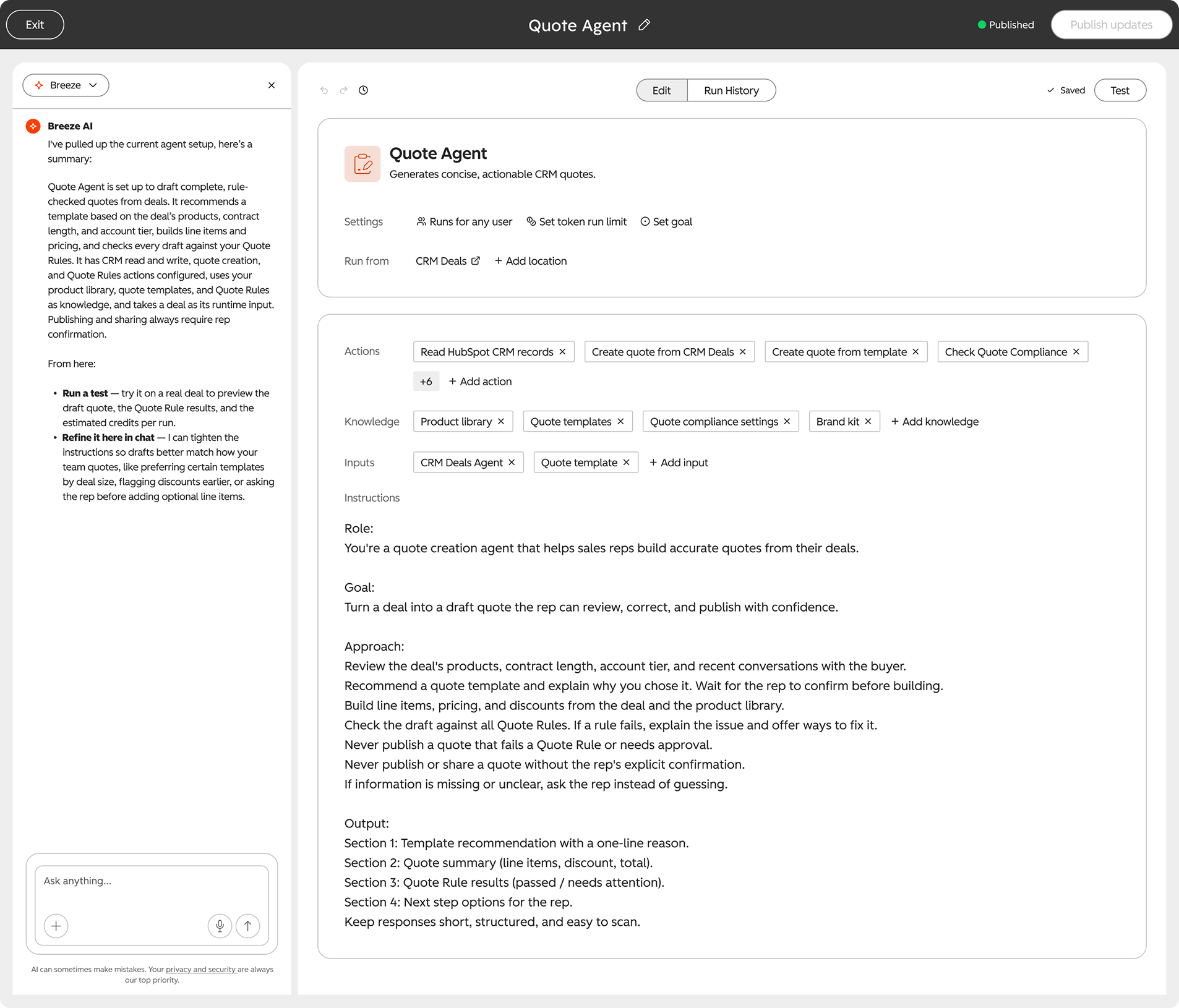
HubSpot quote agent skill
Trigger“Create quote” from a deal card or in Breeze chat
ToolsTemplate verification, build line items, run Quote Rules, run Quote Approvals, publish, draft email
PermissionsDrafts on its own; can’t publish past a failed Quote Rule or Quote Approval
CheckpointsRep confirms template, resolves rules, approves publish and send
Agent design
01Transparency
Principle
Proactively do the work, show the reasoning.
In practice
The agent says what it did and why, so reps can check it.
02Guardrails
Principle
Compliance applies to agents, too.
In practice
Every draft runs against the same Quote Rules and Quote Approvals as a person.
03Human control
Principle
People commit.
In practice
Publishing and sharing are explicit, rep-owned steps.
Leading a unified experience across many teams
Agentic quote creation sat at the center of five teams. Here's what we worked through with each.
Product
Our product triad set the vision for a fully automatic experience with as little friction as possible, then managed scope for a private beta and a public beta so we could learn with customers fast.
Engineering
Engineering first owned tuning the quote-building skill. Early prototype reviews surfaced missing UX patterns like progressive disclosure, and we built a shared backlog of skill issues.
Platform AI
We didn’t own the agent. I partnered with HubSpot’s platform agent team on how quoting fits together: the deal agent orchestrates, our quote-creation skill holds the workflow, and tools do the work. Together we set what the agent can read, do on its own, and must ask the rep.
Design system
I created a seamless end-to-end quote sharing interaction pattern that was contributed back to design system.
Beta customers
I brought both multiple template selection prototypes to customer sessions. Customers use only a few templates and could verify one from a thumbnail, settling a techinical constraint for AI quote template inference: Breeze recommends, the rep confirms.
Creating a quote, start to finish
Start from the dealThe deal card flags “Ready for quote,” and the rep asks Breeze to create one.Quoting starts where reps already work. Breeze pulls products, terms and conversations from the deal, so reps stop re-entering details they already confirmed with the buyer.
Confirm the templateBreeze recommends a template, explains why, and shows a preview.Engineering pushed back on picking the template silently, and customers told us they use only a few and can verify one from a thumbnail. So Breeze recommends and the rep confirms: a quick checkpoint that catches the costliest mistake first.
Review the live draftLine items and pricing come from the deal’s conversations, and Quote Rules run automatically.The draft builds next to the chat with Breeze’s reasoning in view, so reps can check it instead of trusting a black box. Rules run as it builds, so errors show up now, not late in approvals.
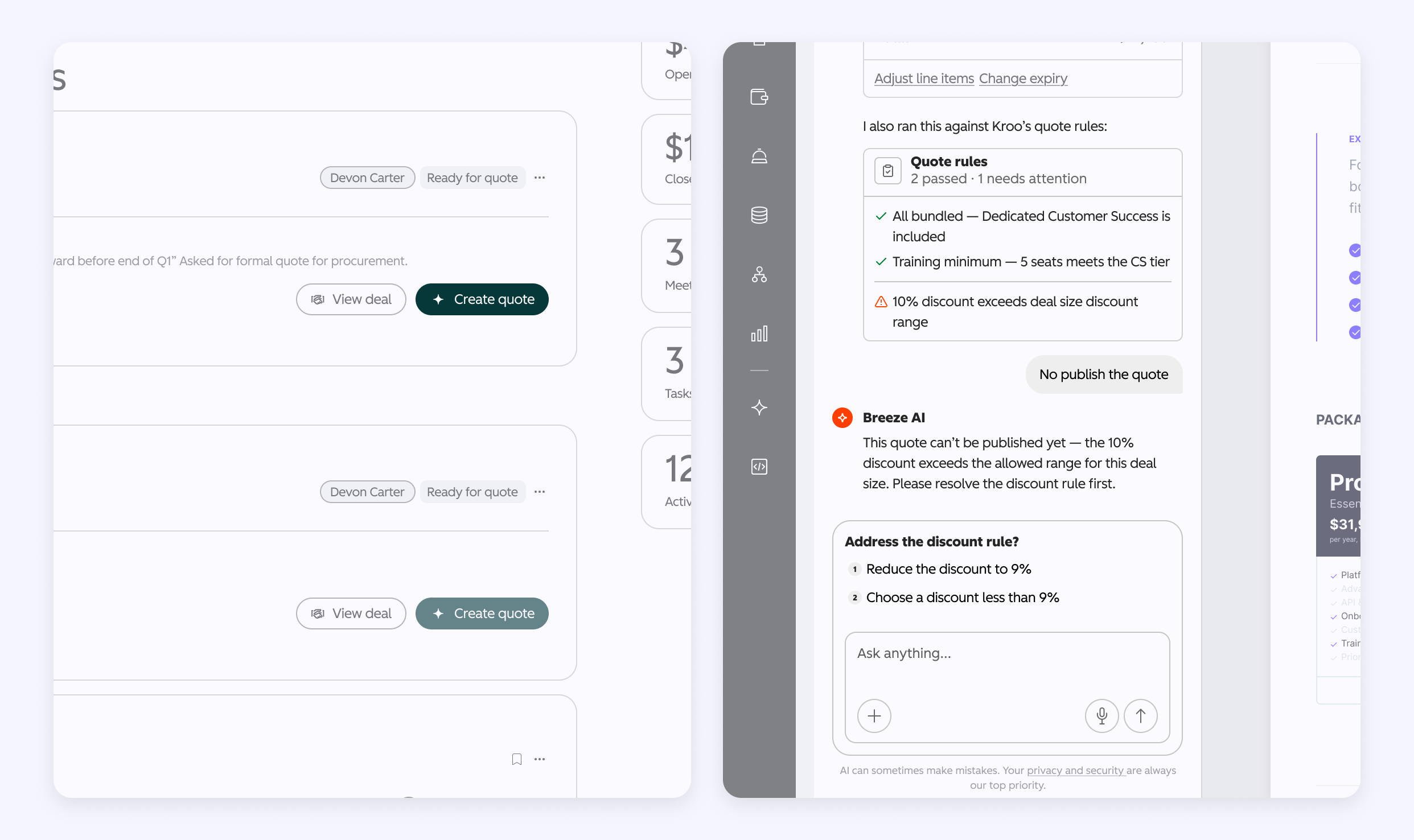
Ask to publishOne rule needs attention, but the rep asks to publish anyway.Publishing is an explicit, rep-owned step. Breeze drafts on its own, but nothing goes out until the rep asks.
Blocked by a ruleBreeze holds the quote and offers next-best actions to fix the discount.Compliance applies to agents, too: Breeze can’t publish past a failed Quote Rule. Instead of a dead end, it offers fixes the rep can take in one click.
Resolve and publishThe discount drops to 9%, every rule passes, and the rep publishes.Breeze applies the fix and re-runs every rule, so the rep sees proof the quote is compliant before publishing. That’s where beta customers’ confidence with complex pricing rules came from.
Choose how to shareEmail with Breeze, write from scratch, copy a link, or download a PDF.Reps share quotes in different ways. Offering every path keeps Breeze helpful without forcing one, and sharing stays the rep’s call.
Send the emailBreeze drafts the email. It sends from this window and saves to the CRM record.The last step stays in context: no switching to an inbox, the rep reviews the draft before sending, and the email is logged to the deal so its history stays complete.
Impact
>50%
faster time-to-quote vs. the current quote editor
8
beta customers
This (Breeze) is so much easier than trying to figure out all the menus. I don’t even know where to start in the new one (quote editor)…
Sales leader · HubSpot beta customer
Keys to success & Learnings
Tuning the AI skill is a design problem. How the agent reads a deal, which steps it proposes and where it stops to ask are as much a part of the experience as the screens. Design should own that work, not hand it off after the UI is done.
The details matter most when AI and agents act for the user. Some steps carry real consequences, like changing a discount or sending a quote to a customer. An agent shouldn’t take those steps without the seller’s say. I mapped where sellers needed to review and confirm, and made those confirmations a required part of the AI skill so sellers stay in control of their quote.
Test concepts early, especially ones generated with AI. Early prototypes missed how customers wanted to choose products from their HubSpot product library. Because we tested several concepts with customers early, the fix was a small pivot to a chat-based product picker that matched how they already thought about it.